
It is an established fact that utilities such as water, gas, and electricity are life essentials. After the need for oxygen to breathe, we literally need drinking water to survive. Additionally, gas and electricity serve as fundamental utilities which enable our comfortable existence by helping us cook food while providing entertainment options and maintaining connectivity in the digital era. This evidence makes it clear that the utilities industry serves as an indispensable sector by delivering essential resources for both residential and commercial purposes. The skills needed for gas and water extraction as well as their treatment and efficient distribution hold enormous importance. However, despite its necessity, still faces difficulties in both attracting new workers and keeping existing employees. As younger generations place increasing emphasis on work-life balance, purpose-driven employment, and benefits beyond just salary, organizations in the utilities sector must redesign employee benefits to meet these expectations. This paper aims to analyze how the design of employee benefits will evolve in the UK utilities sector by 2030, based on workforce demographic trends and emerging employee expectations.
1. Ageing Workforce
The utilities sector in the UK faces an urgent problem due to its workforce composition which remains predominantly within the age range of 46 to 55 years. The Water Magazine (2024) reports that by 2030 the industry will see retirement of more than 105,000 employees which represents approximately 17% of the workforce and this figure includes 33,000 workers who have already surpassed their expected retirement age. The Energy and Utilities Skills Partnership estimates that the sector must fill 312,300 positions by 2030 as depicted in the table below.
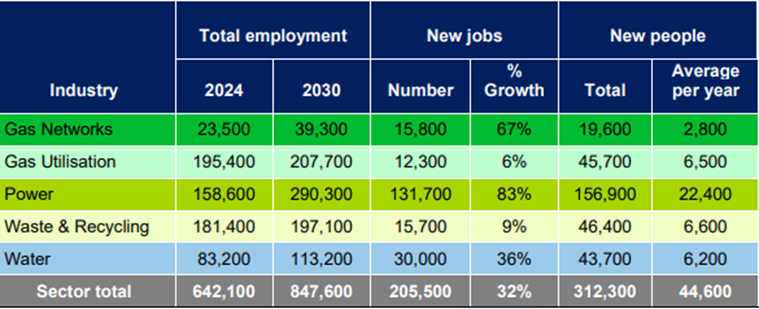
The departure of these skilled workers poses a serious risk to the industry’s stability, as attracting and retaining talent within the sector remains difficult. Four primary causes of this shortage include an ageing workforce, gender disparity, a skills mismatch, and low attractiveness. To bridge the skills gap, employee benefits must be redesigned to attract individuals aged 16-24, who currently show little or no interest in the sector. This is especially critical as technological advancements will require new skills to operate automated industry equipment.
2. Gender disparity
The utilities sector has traditionally been male-dominated, and gender disparity remains a significant issue. According to the Energy & Utilities Skills Partnership (2023), females in the industry declined from 30% in 2023 to 28% in 2024. This suggests that beyond recruitment, retaining female employees poses a major challenge for the industry. For instance, data from the Office for National Statistics revealed that women employed in water collection, treatment, and supply fell from 27,974 in 2022 to 24,332 in 2023.
Women also remain underrepresented in leadership, holding only 29% of board positions and 16% of executive roles across the top 80 UK energy companies in 2023 and 2024. Out of these, just three had a female chair, and only four were led by female CEOs, highlighting ongoing barriers to career progression (Muscat et al., 2024). This limited leadership opportunities discourage female participation as FMJ Jobs (2024) reports that female workers leave the industry at twice the rate of men. So far, initiatives to boost female participation in the sector have either failed to deliver results or produced only temporary gains. For example, Thames Water attempted to address gender bias in hiring by removing ‘masculine’ terminology from job ads, resulting in an increase in female applicants from 8% to 46% but this doesn’t resolve gender disparity. The sector must adopt a broader strategy that offers benefits such as workplace flexibility, career development opportunities, and leadership paths to enhance retention and draw in more women.
CASE STUDY: OCTOPUS ENERGY
Octopus Energy stands out as a leading employer in the UK utilities sector and received accolades as both the best company to work for and the top energy supplier during 2025 (Toth, 2025; Gallizzi, 2025). Employee reviews praise its open culture, encouragement of innovation, and high job satisfaction. Consequently, this case study examines what makes Octopus stand out in the energy sector and explores how its approach can inspire other companies.
A key benefit is its Equity Option Scheme, allowing employees to own shares, aligning individual success with company performance and fostering long-term commitment. Unlike traditional energy firms, Octopus prioritizes shared financial growth over fixed salaries alone. The company also excels in family-friendly policies, offering tax-free childcare, generous parental leave, and child-friendly office spaces. Employees can even bring their children to work when necessary, a rare flexibility in the utilities sector that supports work-life balance, particularly for women.
Other benefits Octopus offers that energy and utility companies can adopt include:
- Free meals and drinks, helping employees cut food expenses.
- Wellness programs, such as a weekly live yoga class for mental and physical well-being.
- Diversity and inclusion efforts, with nearly equal gender representation (51.2% female, 48.8% male), supported by targeted recruitment campaigns.
- Inclusive hiring practices, including unconscious bias training and broader participation in recruitment decisions.
- Hybrid and remote work options, ensuring flexibility with fully remote and agile teams.
CONCLUSION
To address the demographic challenges in the utilities sector, employee benefits by 2030 must attract and retain women and younger workers. Research shows that women, like Gen Z (born 1997 – 2012), prioritize flexible work options, yet many feel unseen in the industry, impacting career progression (Women’s Utilities Network, 2024). Offering benefits such as equal pay and transparency, career development, and an inclusive culture can reduce female attrition and attract talent.
Beyond standard benefits like pensions and hybrid work, industry-specific perks can enhance retention. For instance, Centrica offers employees a 15% discount on energy bills, and expanding Equity Option Schemes, like Octopus Energy’s, can boost engagement. Furthermore, pay disparities remain an issue, with utilities salaries 12% below the industry median and water sector earnings 30% lower as reported by Maheswaran and Liu (2024). Addressing compensation gaps should be a priority in designing future benefits to close the skills gap by 2030.
REFERENCES
Energy & Utility Skills (2024) ‘Over 300,000 new roles across the energy and utilities sector needed by 2030’. Water Magazine, 16 September. Available at: https://www.watermagazine.co.uk/2024/09/16/over-300000-new-roles-across-the-energy-and-utilities-sector-needed-by-2030/ (Accessed: 13 March 2025).
FMJ Jobs (2024) How to get more women in utilities. Available at: https://www.jobs.fmj.co.uk/blog/view/524/How-To-Get-More-Women-In-Utilities (Accessed: 14 March 2025).
Gallizzi, B. (2025) Big Six energy suppliers guide. Uswitch, 3 February. Available at: https://www.uswitch.com/gas-electricity/guides/big-six-energy-suppliers-guide/ (Accessed: 14 March 2025).
Maheswaran, P. and Liu, K. (2024) 2024 compensation opportunities for the UK’s energy and natural resources sector. WTW. Available at: https://www.wtwco.com/en-gb/insights/2024/02/2024-compensation-opportunities-for-uks-energy-and-natural-resources-sector (Accessed: 11 March 2025).
Muscat, O., Donaldson, K., Arroyo, A., and Patel, N. (2024) The state of gender representation in the UK energy industry. Bain & Company. Available at: https://www.bain.com/insights/the-state-of-gender-representation-in-the-uk-energy-industry/ (Accessed: 13 March 2025).
Toth, A. (2025) Best places to work in the UK 2025: Full list revealed. The Independent, 14 January. Available at: https://www.independent.co.uk/news/uk/home-news/best-places-to-work-uk-2025-list-b2679318.html (Accessed: 12 March 2025).
Women’s Utilities Network (2024) Unconscious bias white paper. Available at: https://thewun.co.uk/wp-content/uploads/2024/04/WUN4157-WUN-Unconscious-Bias-White-Paper-v3-DIGITAL-2.pdf (Accessed: 13 March 2025).